Judy’s in Bangor, Maine, is “home of the best omelet in town.” It’s been around long enough that one patron posted that Judy’s had been his father’s favorite restaurant when he was growing up, and he was wondering if maybe he was sitting on the same bar stool his father had sat on.
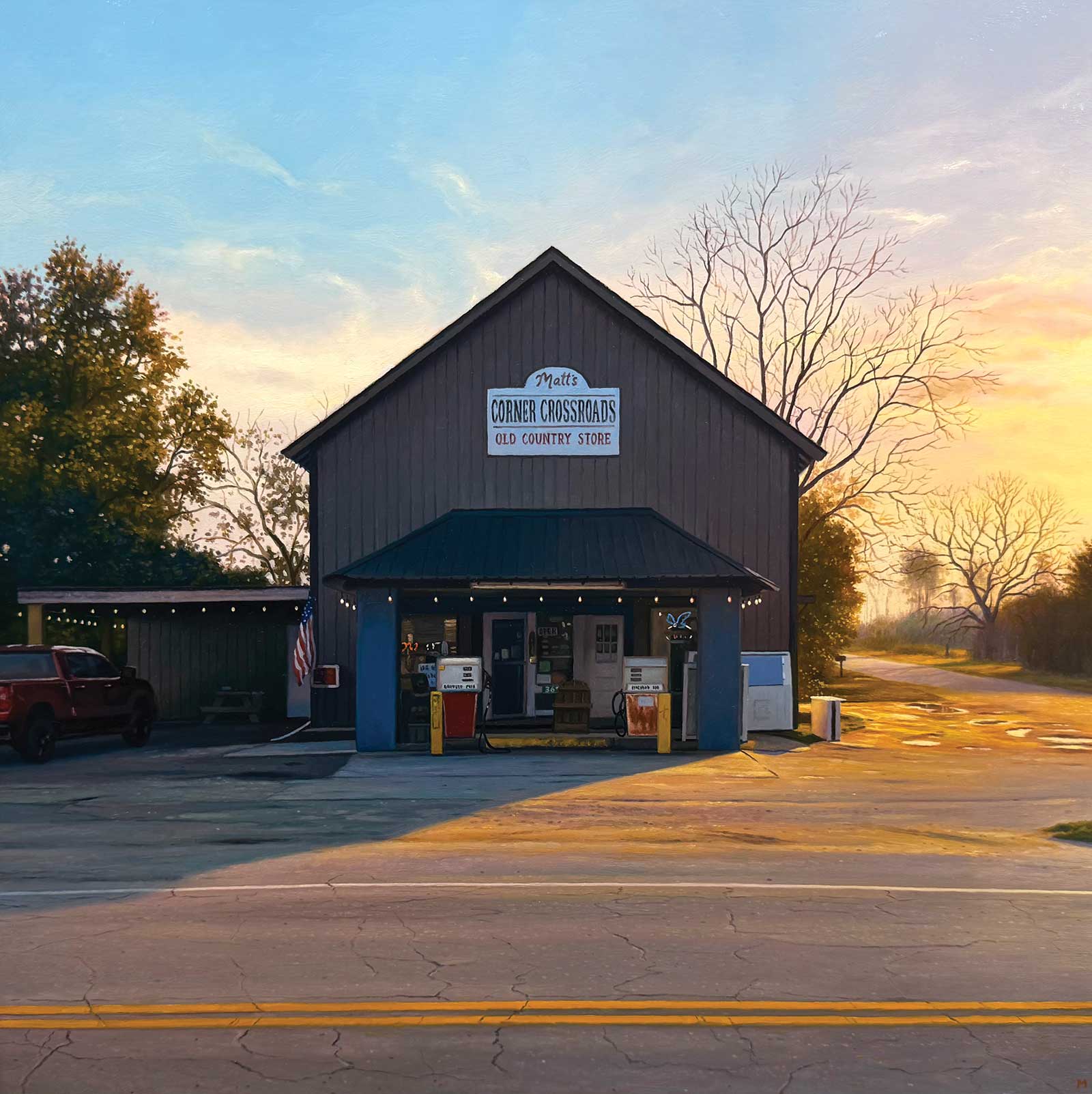
Matt’s Old Country Store, oil on panel, 14 x 14 in.
Matthew Cornell “grew up on the road,” moving often when his Air Force father was reassigned and taking road trips in the family station wagon. Gazing out of the car window he observed the weather, the changing landscape and the roadside houses and businesses. “The constant moving has greatly influenced my new work,” he says. “I am searching for that elusive notion of where I come from and where I belong.”
There’s a car passing Judy’s in his painting of the same name. “If you see a single car on a highway, it’s a self-portrait,” he explains. “That’s me placing myself in the paintings. It’s a compositional device, but it’s also meant to represent me traveling or searching...”
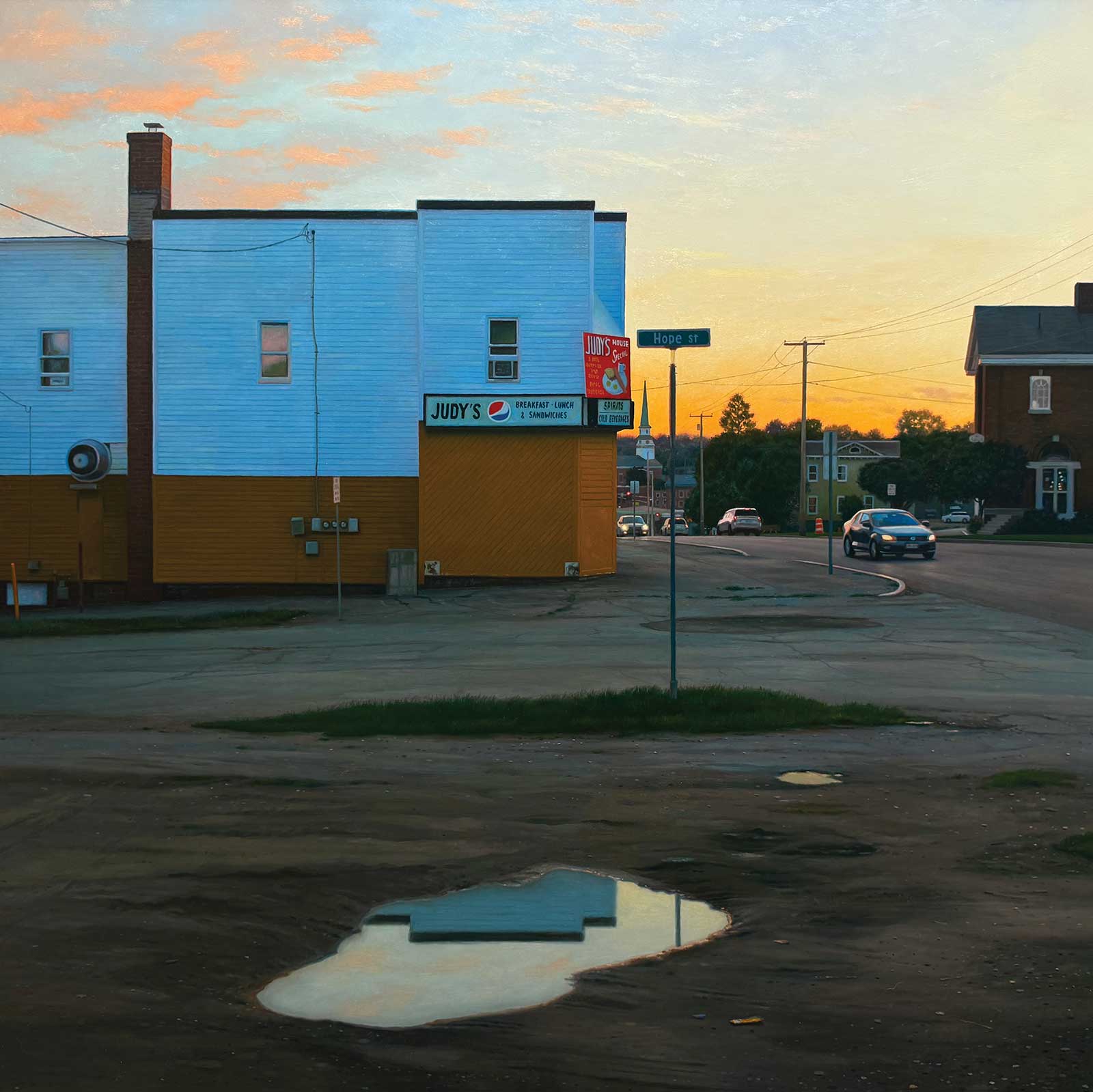
Judy’s, oil on panel, 24 x 24 in.
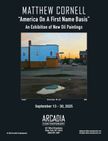
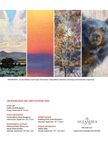
An exhibition of his new paintings, Matthew Cornell: America on a First Name Basis opens September 13 and runs through September 30 at Arcadia Contemporary in New York.
Several years ago, on a road trip to his wife’s native Michigan, he relates, “I couldn’t help but notice all the places on the highway had peoples’ first names. It got me thinking about connecting to a place and making it more personal. I think about the people who occupied houses over time and the long story of a business that once had a heyday. I still feel like hope is imbued in business people.”
When working on the composition of Judy’s, he says he “wandered around to get an interesting point of view. When I was working on the painting I thought it would also be interesting to have something in the foreground and painted the puddle and the reflection.” He also inserted a subtle sign reading “Hope St.”
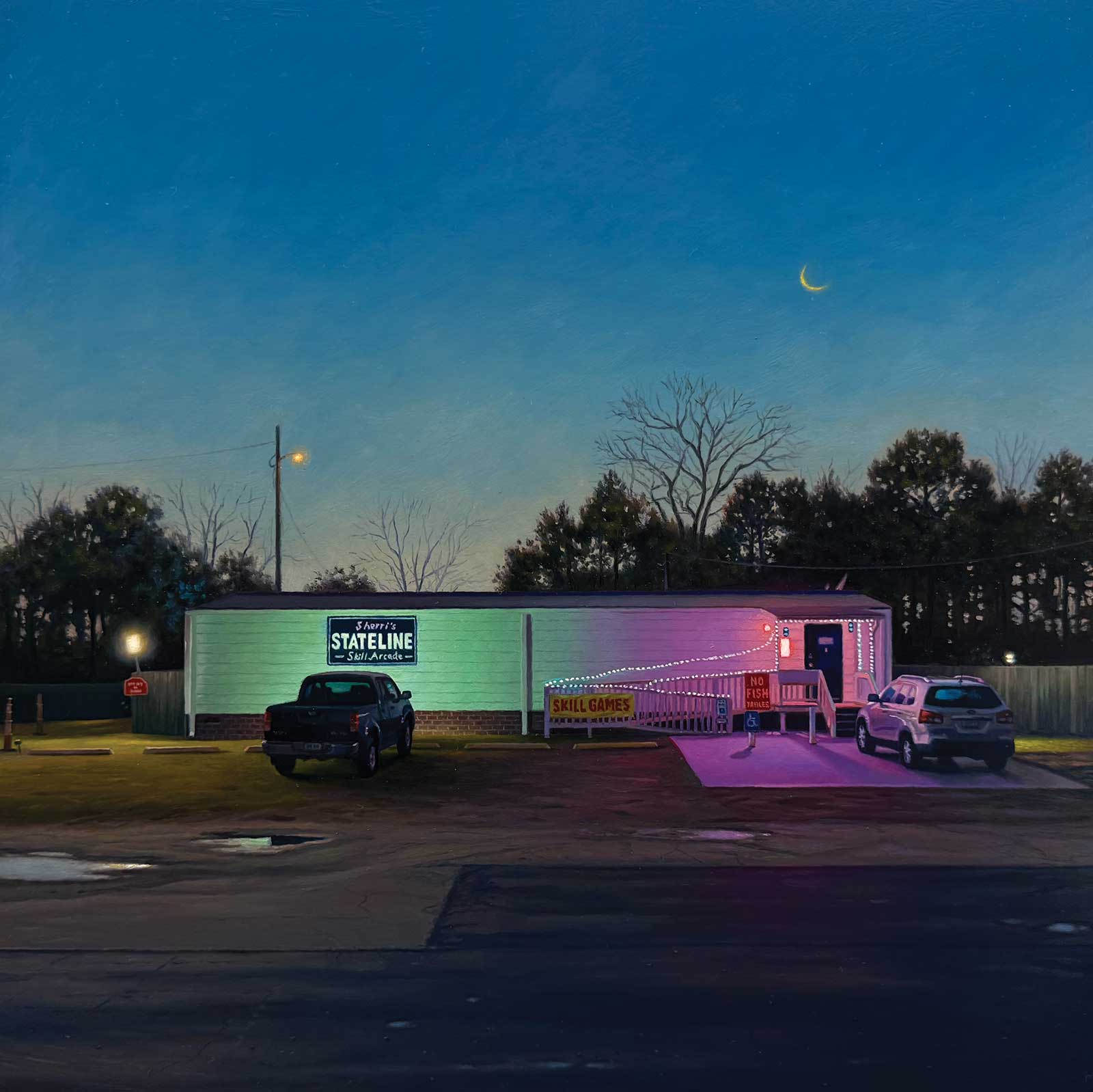
Sherri’s Skill Arcade, oil on panel, 12 x 12 in.
He was initially attracted by the orange paint on Don’s house which is heightened by the late afternoon light. “The light at twilight and dawn makes places more interesting,” he says. “I used to paint plein air but often, with the kind of place I want to paint, it’s not practical to be standing in the middle of the road in fleeting twilight. I still make some studies but use photos for references and often move things around.”
Don’s House, in addition to its color, has an air of mystery with its paper-covered windows and a “Sorry We’re Closed” sign indicating it must once have housed a business. The sign frame is empty and a political flag hangs limply on the pole.
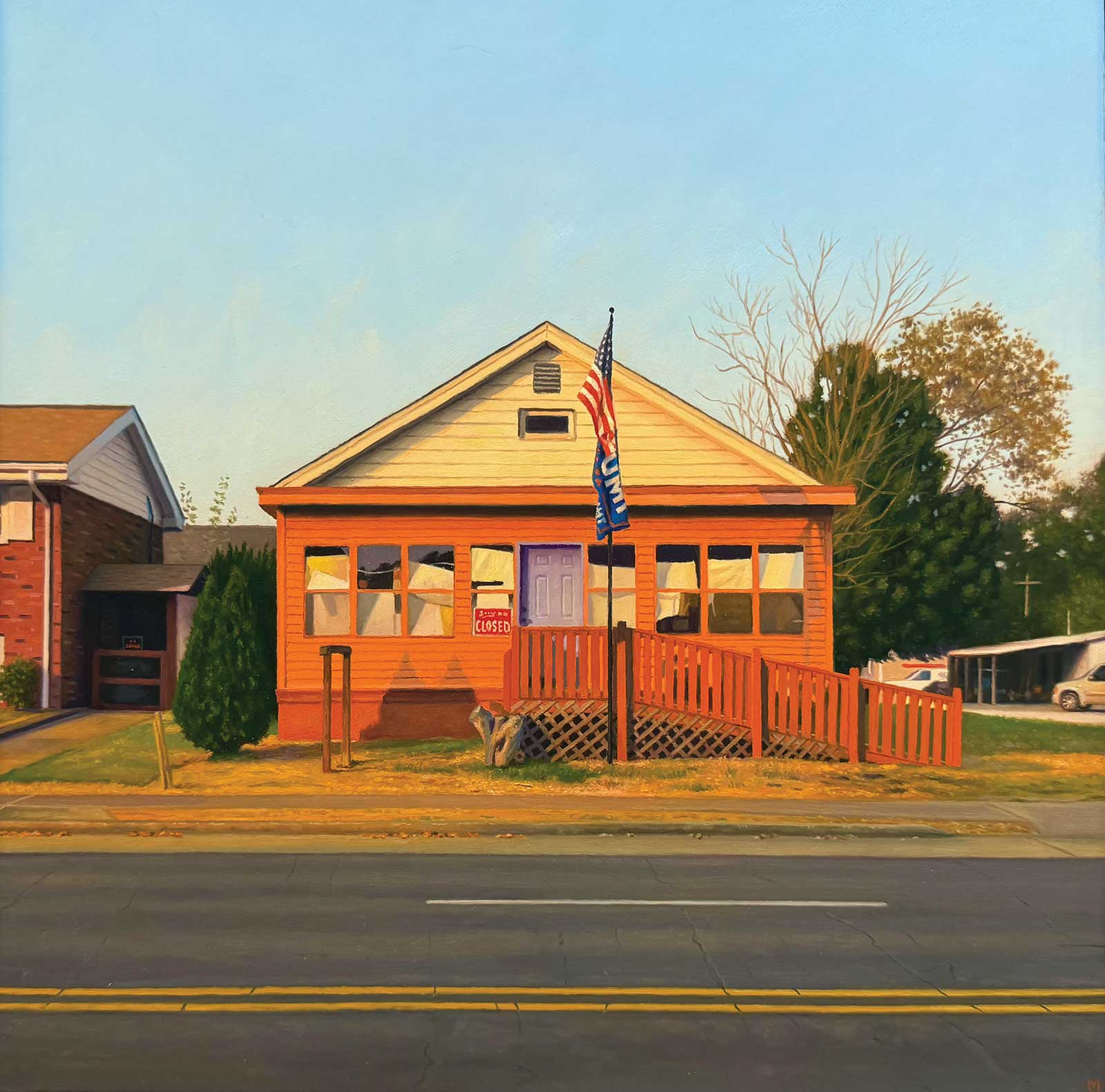
Don’s House, oil on panel, 10 x 10 in.
The eponymous roadside businesses are a connection to the people who opened and operate them. Sometimes the ego is large as in Porky’s, whose name is brightly lit while the lights have blown out on the sign that indicates what Porky’s is.
Cornell asks, “What do these places say about us as the cornerstones of small towns and communities? What is the long arc of the story of place? Do we need that connection knowing they’re named after and owned by people? I stop to talk with the people and they’re just regular folks. For me it’s the kind of America I remember as a child, an experience I can connect to. When I’m finished with a painting, people often say it looks like a familiar place to them even if it isn’t.”
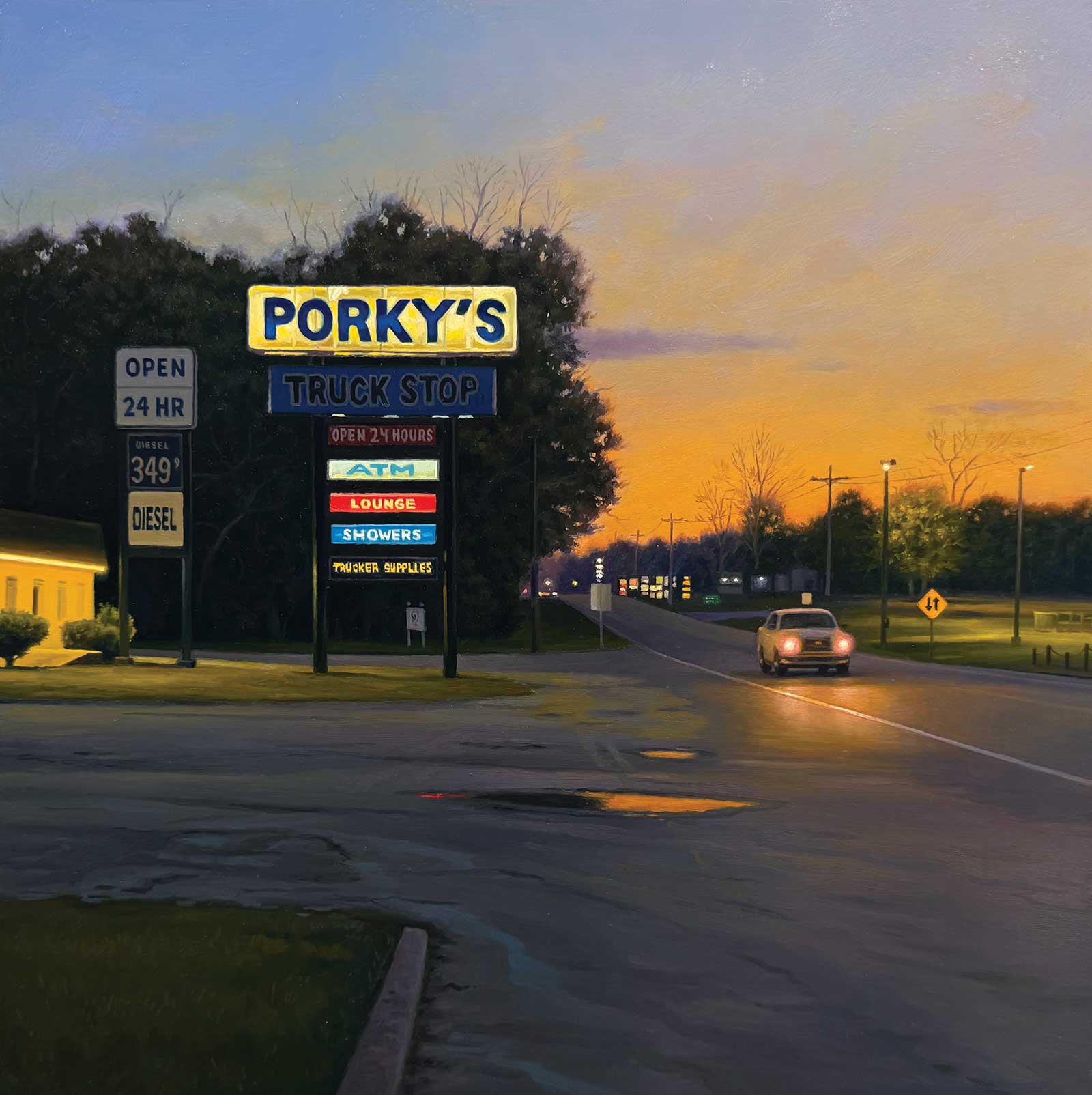
Porky’s, oil on panel, 12 x 12 in.
The stories and the mysteries of the places Cornell celebrates in his paintings reflect his own search for place, sometimes coming close, sometimes falling short. The novelist Madeleine L’Engle wrote, “We are all strangers in a strange land, longing for home, but not quite knowing what or where home is. We glimpse it sometimes in our dreams, or as we turn a corner, and suddenly there is a strange, sweet familiarity that vanishes almost as soon as it comes.” —
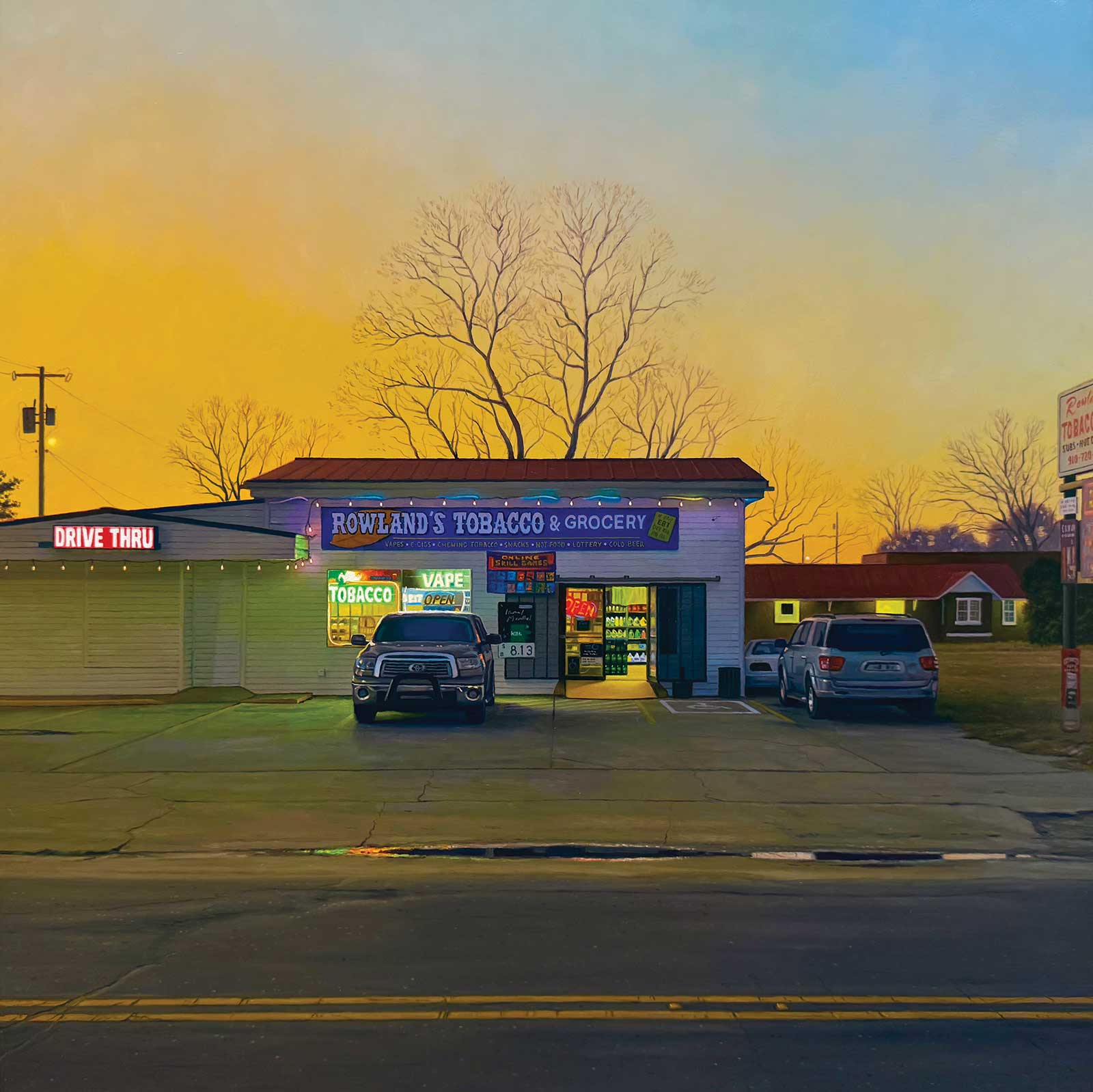
Rowland’s Tobacco & Grocery, oil on panel, 18 x 18 in.
Arcadia Contemporary 421 W. Broadway New York, NY 10012 • (646) 861-3941 • www.arcadiacontemporary.com
Powered by Froala Editor